
Why Irrigation Pipe Joints Leak in Summer — And How Farmers Can Prevent Water Loss
Water is the lifeblood of any commercial farming enterprise. During the scorching summer months, crop transpiration spikes, evapotranspiration rates soar, and irrigation systems are pushed to their absolute limits. Yet, summer is precisely when irrigation infrastructure is most vulnerable to failures—specifically at the connections, couplers, flanges, and fittings.
Irrigation joint leakage is a documented, pervasive challenge in modern agriculture. Even a handful of minor joint leaks can waste thousands of gallons of water per acre each week, bleed pumping energy, cause localized waterlogging, and starve downstream crops of required pressure.
Understanding the physics and chemistry behind summer pipe-joint failures allows growers, farm managers, and irrigation technicians to implement proactive, cost-effective solutions before heatwaves strike.
Table of Contents
The True Cost of Irrigation Water Loss in Agriculture
Before examining mechanical failure modes, it is crucial to understand what leaky joints actually cost a farm:
- Direct Water Depletion: In gravity-fed or pressurized systems, a small continuous leak of 5 gallons per minute (GPM) across ten faulty joints wastes 72,000 gallons per day. In drought-prone regions where water allocations are capped or purchased per acre-foot, this directly cuts into profitability.
- Energy Inefficiency: Pumping water requires diesel or electricity. When pressure drops due to joint leakage, pumps run longer cycles or variable frequency drives (VFDs) ramp up RPMs to maintain line pressure, driving utility bills up significantly.
- Loss of Uniform Distribution: Modern drip and micro-sprinkler systems depend on precise pressure regulation. Leaking mainline or sub-main joints cause pressure differentials, resulting in over-saturated soil around the leak and water-stressed, stunted crops at the end of the line.
- Soil Erosion and Root Rot: Localized ponding around leaking joints drowns root zones, promotes soil-borne fungal pathogens (such as Phytophthora and Pythium), and washes away valuable topsoil and applied fertilizers (fertigation leaching).
Why Pipe Joints Fail Specifically in the Summer
Pipe systems face a multi-factor assault in warm weather. Below are the five primary drivers of summer irrigation joint failure.
         High Ambient Heat & Solar Radiation
                        │
                        ▼
    ┌────────────────────────────────────────┐
    │  Thermal Expansion & Differential      │
    │  Movement (Pipes expand, push/pull)   │
    └───────────────────┬────────────────────┘
                        │
         ┌──────────────┴──────────────┐
         ▼                             ▼
┌──────────────────┐          ┌──────────────────┐
│ Gasket / O-Ring  │          │ Hydraulic Strain │
│ Degradation &    │          │ & Water Hammer   │
│ Ageing           │          │ Over-pressure    │
└────────┬─────────┘          └────────┬─────────┘
         │                             │
         └──────────────┬──────────────┘
                        ▼
              Joint Seal Failure &
               Severe Water Leakage
A. Thermal Expansion and Contraction (The Heat Effect)
Agricultural piping materials—particularly Polyvinyl Chloride (PVC), High-Density Polyethylene (HDPE), and Low-Density Polyethylene (LDPE)—have high coefficients of thermal expansion:
- PVC expands roughly $3 \text{ to } 3.5 \text{ inches}$ per $100 \text{ feet}$ over a $50^\circ\text{F}$ temperature swing.
- HDPE expands even more dynamically, moving up to $4 \text{ times}$ more than PVC under equivalent solar exposure.
During peak summer, surface pipe temperatures can fluctuate from $65^\circ\text{F}\,(18^\circ\text{C})$ at night to over $130^\circ\text{F}\,(54^\circ\text{C})$ under direct midday sunlight.
- The Mechanism: As the pipe expands longitudinally, it pushes into bell-ends, mechanical couplers, and compression fittings. When it cools at night, it contracts, pulling away from fittings. This cyclic mechanical movement gradually works joints loose, walks O-rings out of their seating grooves, and breaks solvent-cement bonds.
B. Material Ageing, UV Embrittlement, and Gasket Dry-Rot
Above-ground surface lines face intense ultraviolet (UV) radiation combined with ambient heat:
- Elastomeric Gaskets (EPDM/Buna-N): Rubber gaskets inside quick-coupling aluminum pipes, grooved couplings, and PVC gasketed bells contain plasticizers that volatilize under prolonged heat. The rubber hardens, cracks, loses elasticity (taking a permanent compression set), and can no longer form a tight seal against thermal movement.
- UV Embrittlement of Plastics: Unprotected PVC exposed to direct sunlight degrades via photo-oxidation. The material becomes chalky, brittle, and loses tensile strength, making joints susceptible to micro-fissuring and cracking under standard operating pressure.
C. Increased Operating Pressure and Thermal Hydraulic Shock
During summer, peak irrigation demand means systems operate near continuous capacity:
- Trapped Air & High Flow Velocities: Rapid line filling during hot weather pushes air pockets through lines. When moving water hits trapped air or closed valves, it produces sudden pressure spikes (water hammer).
- Thermal Expansion of Trapped Water: If isolation valves are closed while liquid sits inside above-ground pipes under direct sun, the expanding trapped water can raise hydrostatic line pressure well beyond the pipe’s rating, blowing out the weakest link: the joints.
- Pump Cycling: Deep-well turbines and booster pumps run frequently, inducing cyclic hydraulic fatigue on joint seals.
D. Poor Initial Connection and Installation Errors
Improper installation often stays hidden in spring when temperatures are mild, only to fail under summer stress:
- Inadequate Insertion Depth: Pipes not inserted to full bell depth slip out as thermal contraction pulls the line in cooler hours.
- Improper Solvent Welding: Applying PVC primer and cement in high ambient temperatures ($>95^\circ\text{F} / 35^\circ\text{C}$) causes solvents to flash off (evaporate) too fast before the chemical weld forms properly, creating weak, porous glued joints.
- Misaligned Connections: Laying pipes across uneven terrain without proper grading places lateral shear stress directly on couplers and gasketed sockets.
E. Physical Damage and Soil Settling
Summer agricultural operations introduce mechanical hazards:
- Tractor & Equipment Passes: Heavy field machinery operating close to header lines and valve boxes can deflect buried pipes and stress joint collars.
- Soil Shrinkage: Heavy clay soils contract and crack open during dry summer spells, removing structural support underneath pipe bells and causing joints to sag and separate.
Comparing Joint Types & Vulnerabilities
| Joint Type | Common Agricultural Application | Primary Summer Failure Mode | Preventative Countermeasure |
| Gasketed Bell (PVC) | Mainlines & Sub-mains | Gasket roll-out; pull-out from nighttime thermal contraction | Use expansion joints; bury below frost/heat line; proper thrust blocking |
| Solvent-Welded (PVC) | Manifolds, Drip Headers | Brittle fracture; weak weld from hot-weather glue application | Use hot-weather solvent cements; shade headers; install flexible loops |
| Compression / Lock Fittings | Polyethylene Drip Lines | Softening of poly tube in high heat causes blowout off barb | Use outer lock collars; reduce operating pressure; bury lateral lines |
| Quick-Couple (Aluminum) | Portable Sprinklers, Wheel Lines | Hardened/dried hook gaskets; latch fatigue | Soak gaskets before use; replace worn latches; inspect yearly |
| Electrofusion / Butt Fusion (HDPE) | High-Pressure Mainlines | Cold joints during install failing under thermal shear | Strictly adhere to qualified fusion parameters and cooling cycles |
Comprehensive Prevention & Maintenance Guide for Farmers
Preventing summer water loss requires a balanced strategy of proper installation practices, system retrofits, and scheduled operational inspections.
                   Summer Leak Prevention Strategy
                                  │
    ┌─────────────────────────────┼─────────────────────────────┐
    ▼                             ▼                             ▼
System Design & Prep          Installation Rules           Field Monitoring
• Bury below heat zone        • Use hot-weather cement      • Flow rate tracking
• Install thrust blocks       • Allow expansion snaking     • Ultrasonic leak audits
• Fit air-release valves      • Pre-lubricate gaskets       • Scheduled pressure checks
Step 1: Optimize System Hydraulics and Valve Placement
- Install Automatic Air/Vacuum Relief Valves (Continuous Acting):Place air-release valves at every high point in the mainline and immediately downstream of pumps. Expelling air cushions eliminates water hammer surges that crack pipe shoulders and dislodge joint gaskets.
- Incorporate Expansion Joints and Expansion Loops:For above-ground PVC or metal lines exceeding 100 feet, incorporate telescoping expansion joints or U-shaped expansion loops to absorb longitudinal pipe growth without stressing stationary fittings.
- Use Concrete Thrust Blocks on Buried Lines:At bends, tees, reducers, and dead-ends, hydraulic pressure tries to push fittings off the pipe. Pouring adequately sized concrete thrust blocks against undisturbed native soil keeps joints physically anchored.
Step 2: Implement Hot-Weather Installation Standards
When assembling or repairing lines in temperatures above $90^\circ\text{F}\,(32^\circ\text{C})$:
- Use Heavy-Duty, Slow-Setting Solvent Cement: Standard PVC glue sets within seconds in hot weather, preventing proper pipe penetration. Use specially formulated hot-weather primers and cements.
- Work During Cooler Hours: Glue joints or join poly lines in the early morning ($6:00 \text{ AM to } 9:30 \text{ AM}$). This prevents the pipe from being in a pre-expanded state during assembly.
- Provide Slack (“Snaking”) for Polyethylene Pipe: Never stretch HDPE or LDPE lines tight during midday installations. Snake the pipe slightly in the trench so that nighttime contraction does not pull fittings apart.
- Use Silicone-Based Gasket Lubricants: Avoid petroleum-based greases (like motor oil or standard grease) which degrade EPDM rubber. Use certified food-grade silicone pipe lubricant to ensure smooth bell entry without pinching or rolling the gasket.
Step 3: Protect Pipes from Direct Sunlight
- Sub-Surface Burial: Whenever feasible, bury mainlines and sub-mains at least 18 to 24 inches below the soil surface. Soil acts as a natural thermal insulator, keeping pipe temperatures stable between $60^\circ\text{F} \text{ and } 75^\circ\text{F}$ year-round.
- Reflective Paints or Protective Wraps: If PVC must remain exposed above ground (such as manifold backflow assemblies and riser valves), paint the pipe white with outdoor-grade water-based latex paint. White surfaces reflect UV rays and reduce surface temperatures by up to $30^\circ\text{F}$.
Step 4: Early Detection and Daily Monitoring Protocols
- Flow Meter & Pressure Transducer Tracking: Compare baseline flow rate and pressure curves. If mainline pressure drops while flow rate rises unexpectedly, a joint blowout or severe leak has occurred upstream.
- Visual Walking Audits: Inspect field borders, riser joints, and manifold boxes weekly. Look for tells:
- Bright green weed patches in otherwise dry spaces
- Saturated depressions along buried pipe runs
- Muddy pools around quick-coupling risers
- Ultrasonic and Thermal Drone Audits: For large-scale farms (hundreds of acres), early morning drone thermal imaging easily spots cool wet spots along buried lines before water surfaces visibly.
Quick-Action Troubleshooting
If a critical joint fails during an active watering cycle, shutdown times must be minimized to protect crops:
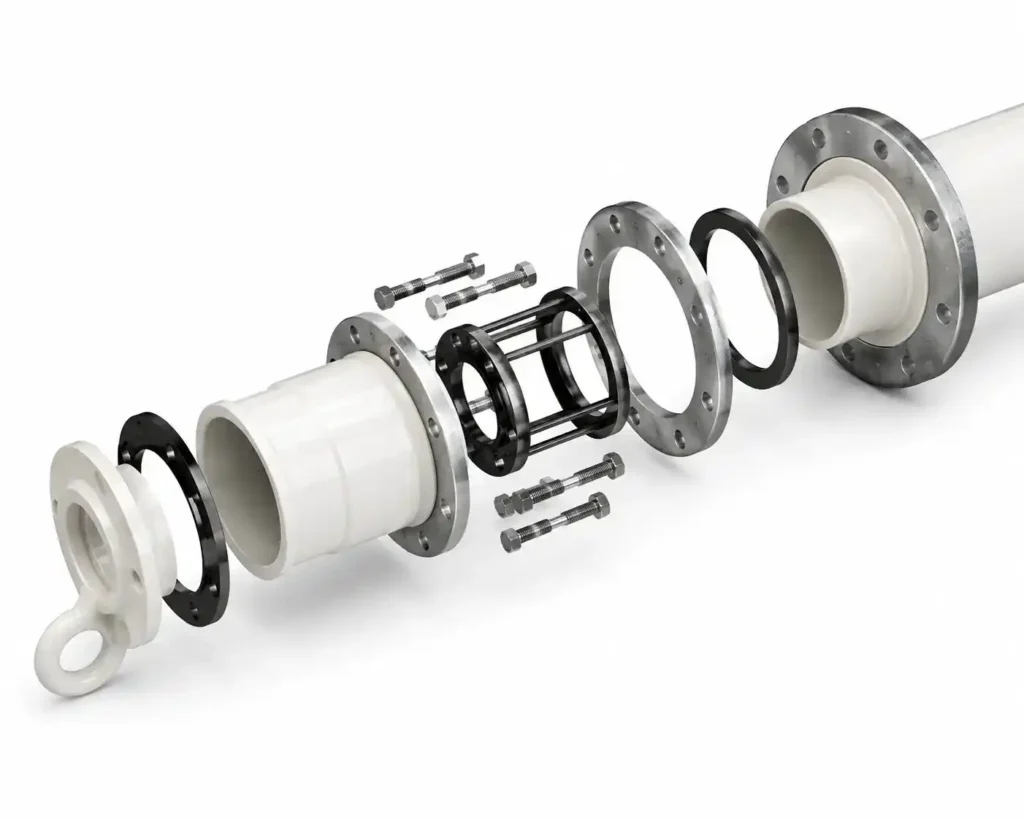
- Temporary Clamp Repairs: Keep stainless-steel repair clamps and rubber wrap kits on hand. They can bridge a split bell or cracked coupling in minutes without cutting the pipe.
- Slip Repair Couplings (Telescoping): For PVC mainline breaks, keep slip-fix expansion repair couplings in your maintenance shop. They slide over cut pipe sections and extend outward, eliminating the need to bend stiff pipe into a standard double-ended coupling.
- Replacing Hardened Gaskets: Maintain a stock of fresh EPDM gaskets in dark, temperature-controlled storage. Never reuse a dried-out gasket by overtightening mechanical bolts; replacing the rubber insert takes under two minutes and provides a factory-grade seal.
How much do PVC and HDPE irrigation pipes expand during a summer heatwave?
PVC pipe expands approximately 3 to 3.5 inches per 100 feet for every $50^\circ\text{F}$ rise in temperature, while HDPE expands up to four times more than PVC. Over a 500-foot run, this expansion can create over a foot of thermal movement, placing intense shear and pull-out stress on stationary joints, couplers, and fittings.
Can I use standard PVC glue to repair leaking pipe joints in extreme heat?
It is not recommended. Standard PVC primer and cement flash off (evaporate) too rapidly in temperatures above $90^\circ\text{F}\,(32^\circ\text{C})$. This rapid drying prevents the chemical solvent weld from properly fusing the pipe and fitting walls, resulting in a weak, porous joint. In high temperatures:
Use specially formulated, slow-setting hot-weather solvent cement.
Perform glue repairs during the cooler morning hours.
What causes quick-couple aluminum and gasketed PVC joints to leak at startup?
This typically stems from two main issues:
Gasket compression set or dry-rot: Over winter or during hot dry storage, rubber O-rings and gaskets lose elasticity and shrink, failing to seat securely against the pipe surface.
Trapped air pressure spikes: When lines are refilled too quickly at system startup, trapped air creates localized shockwaves that momentarily dislodge or roll unseated gaskets.
How can I protect above-ground PVC pipe manifolds and risers from UV damage?
The most cost-effective solution is applying two coats of outdoor water-based white latex paint over the exposed pipe. White paint reflects solar radiation—reducing pipe surface temperature by up to $30^\circ\text{F}$—and shields the plastic polymer chains from photo-oxidation and UV embrittlement. Never use oil-based paints, as their solvents can degrade the plastic.